India's renewable energy expansion is accelerating, but one structural constraint continues to limit scale: land availability.
More than 40 percent of large-scale solar installations in India are already located on agricultural land, creating increasing competition between food production and energy generation.
At the same time, agriculture supports a significant portion of the population and remains highly vulnerable to climate variability. Agrivoltaics in India, the co-location of solar infrastructure and agriculture, has emerged as a potential solution to this land-use conflict.
What is Agrivoltaics?
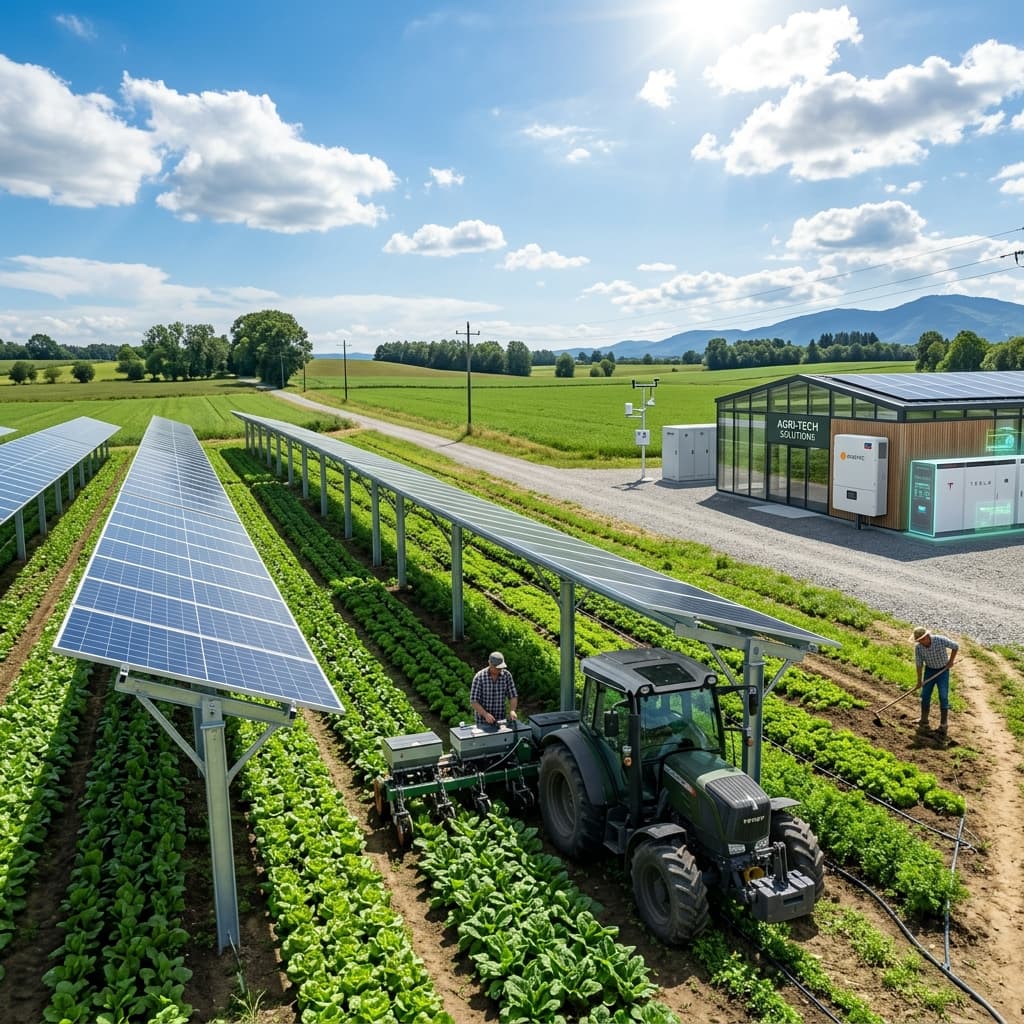
Agrivoltaics refers to the integration of solar photovoltaic systems with crop cultivation on the same land parcel. Unlike conventional solar farms, agrivoltaic solar plants are designed with:
- Elevated module structures to clear tractors and farm machinery
- Optimized spacing between rows to avoid crop shadowing
- Controlled light distribution to balance growth and energy yield
This allows sunlight to be shared between energy generation and plant growth, rather than competing for it.
Why Agrivoltaics Matters in India
1. Land Constraint is Becoming Critical
India has an estimated 748 GW solar potential, but scaling this requires significant land resources. With agriculture already occupying a major share of land, expanding solar without disrupting farming is becoming increasingly difficult.
2. Large Untapped Agrivoltaic Potential
India has approximately 170 million hectares of cultivated land. Out of this, around 6 million hectares are technically suitable for agrivoltaics. This translates to a potential capacity of approximately 3.89 TWp, capable of generating over 5,600 TWh annually, far exceeding projected electricity demand.
3. Growing Market Momentum
The agrivoltaics market in India is projected to grow at a CAGR of approximately 11.5 percent through 2032, indicating increasing commercial interest and investment potential.
Performance and Productivity: What the Data Shows
Higher Land Productivity
Agrivoltaics improves total land output through dual use. Studies show 150 to 160 percent land-use efficiency compared to single-use systems. The Land Equivalent Ratio often exceeds 1.5, meaning combined output is significantly higher than separate systems.
Crop Yield Impact
The impact on crops is crop-specific and condition-dependent:
- Yield increases of up to 30 percent have been observed in some cases.
- Shade-tolerant crops such as leafy vegetables and berries perform better under panels.
- Poor design or unsuitable crops can reduce yields due to light limitations.
Water Efficiency Gains
Partial shading from panels reduces soil evaporation, improves soil moisture retention, and lowers irrigation requirements. Studies indicate an over 30 percent reduction in water usage in certain agrivoltaic setups.
Key Benefits of Agrivoltaics in India
- Dual Revenue Streams: Landowners generate income from electricity generation and agricultural produce, reducing dependency on seasonal farming.
- Climate Resilience: Agrivoltaics helps mitigate heat stress, water scarcity, and extreme weather impact on crops.
- Land Optimization: Instead of allocating land separately, agrivoltaics enables multi-functional land use, improving economic output per acre.
Challenges and Limitations
Despite strong potential, agrivoltaics in India is not universally applicable due to:
- Higher Capital Costs: Elevated mounting structures and customized layouts increase upfront investment.
- Design Sensitivity: System performance is highly dependent on design parameters such as panel height, spacing, and layout. Poor design can negatively impact both energy generation and crop growth.
- Crop Compatibility Constraints: Not all crops are suitable for agrivoltaic systems, and poor selection can reduce yields.
- Policy and Ecosystem Gaps: Limited large-scale deployments, evolving policy frameworks, and a lack of standardized design guidelines.
Best Crops for Agrivoltaics in India
Based on research and field observations, suitable crops include potatoes, spinach, coriander, garlic, and certain legumes. Globally, crops such as lettuce, tomatoes, and berries have also shown strong compatibility with agrivoltaic systems.
From Concept to Execution
At GALACTIC, we see agrivoltaics as a practical step toward improving land productivity rather than just an emerging concept. Its success depends on how well solar design and agricultural planning are integrated at the ground level. For projects to be viable, execution must be driven by site-specific design, not standard templates.
Conclusion
India's energy transition will not be defined only by how much solar capacity is installed, but by how efficiently land is utilized. Agrivoltaics in India offers a measurable advantage: up to 150 to 160 percent higher land-use efficiency compared to single-use systems, potential crop yield improvements of up to 20 to 30 percent in optimized conditions, and water savings of 20 to 30 percent or more due to reduced evaporation.
Done right, agrivoltaics is a high-efficiency model for future-ready solar development, where energy and agriculture can coexist without compromise.
Frequently Asked Questions (FAQ)
Is agrivoltaics proven in India?
Yes, pilot projects and studies show positive results, but large-scale commercial adoption is still evolving.
Does agrivoltaics increase crop yield?
In some cases, yields increase by up to 30 percent due to partial shade and moisture retention, but results depend heavily on crop type and system design.
How much more productive is agrivoltaics?
Studies show up to 150 to 160 percent land-use efficiency (Land Equivalent Ratio > 1.5) compared to separate single-use agricultural or energy systems.
Is agrivoltaics expensive?
Yes, the initial costs are higher due to elevated steel structures and custom wiring, but the long-term returns from dual production offset this initial premium.
What is the future of agrivoltaics in India?
With high land pressure and aggressive renewable energy targets, agrivoltaics is expected to grow steadily as standardized guidelines and financial support models emerge.